From data dashboards to AI that tells the story.
Redesigning AZ Brain, AstraZeneca’s AI-driven sales intelligence platform, so oncology field reps get clear, actionable answers instead of spending their time analyzing data.
- Client
- AstraZeneca
- Product
- AZ Brain — AI sales intelligence
- My role
- Head of Design
- Model
- Retained team embedded in product
- Timeline
- 2022 – 2026
The challenge
As AZ Brain grew across new oncology brands, reps were spending too much time manually analyzing data to find insights.
The mandate
Simplify the experience, increase adoption, and integrate AI that delivers genuine intelligence — not just more data.
The outcome
Reps spend less time on analysis and more on customers — improving sales outcomes and earning internal awards.
01
Context
AZ Brain was built to give AstraZeneca’s field teams actionable insight into their markets and the healthcare professionals they serve. As the platform expanded across new oncology brands and use cases, the volume of data grew with it.
More data didn’t mean more insight. Reps were left doing the analysis themselves — time taken away from the customer conversations that actually move the business.
02
Key decisions
Tell each rep a story, not a dashboard
The call
Replace data-heavy dashboards with narrative visualizations that turn complex data into clear stories.
The tradeoff
Power users still need the numbers, so the underlying data stays one click away for anyone who wants to dig in.
Let the AI do the analysis
The call
AI summaries distill massive amounts of information into plain language: what happened, why, and what to do next.
Alignment
We built trust by having empathy for the people who use the application: we researched and tested the existing app with reps to find out what needed to change to improve their experience and their sales numbers.
Build a framework, not just screens
The call
Co-create a UX/UI framework purpose-built for AI that can scale across brands and use cases.
The balance
Regular working sessions met immediate needs while laying the groundwork for a broader AI design model.
03
Designing for AI
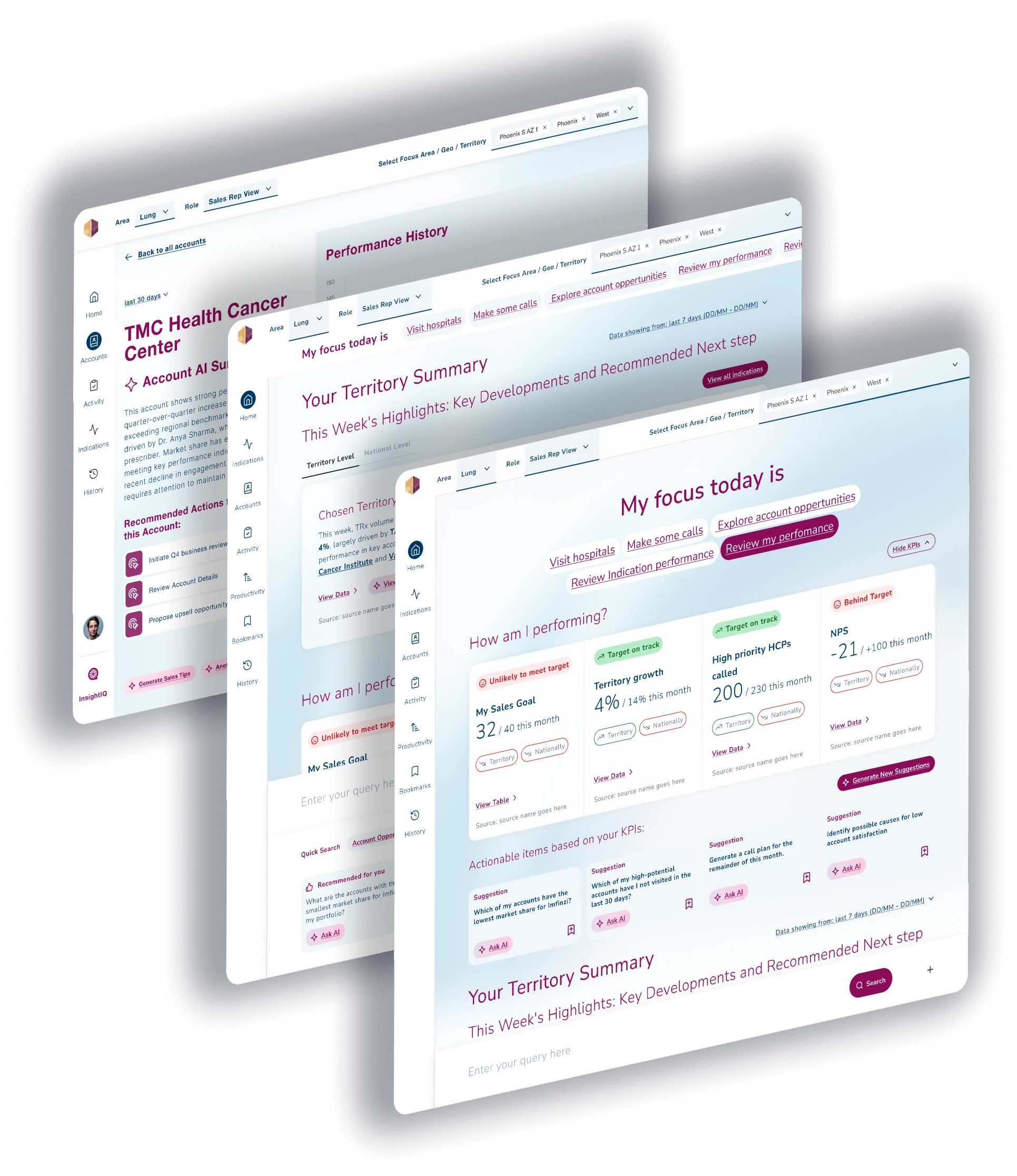
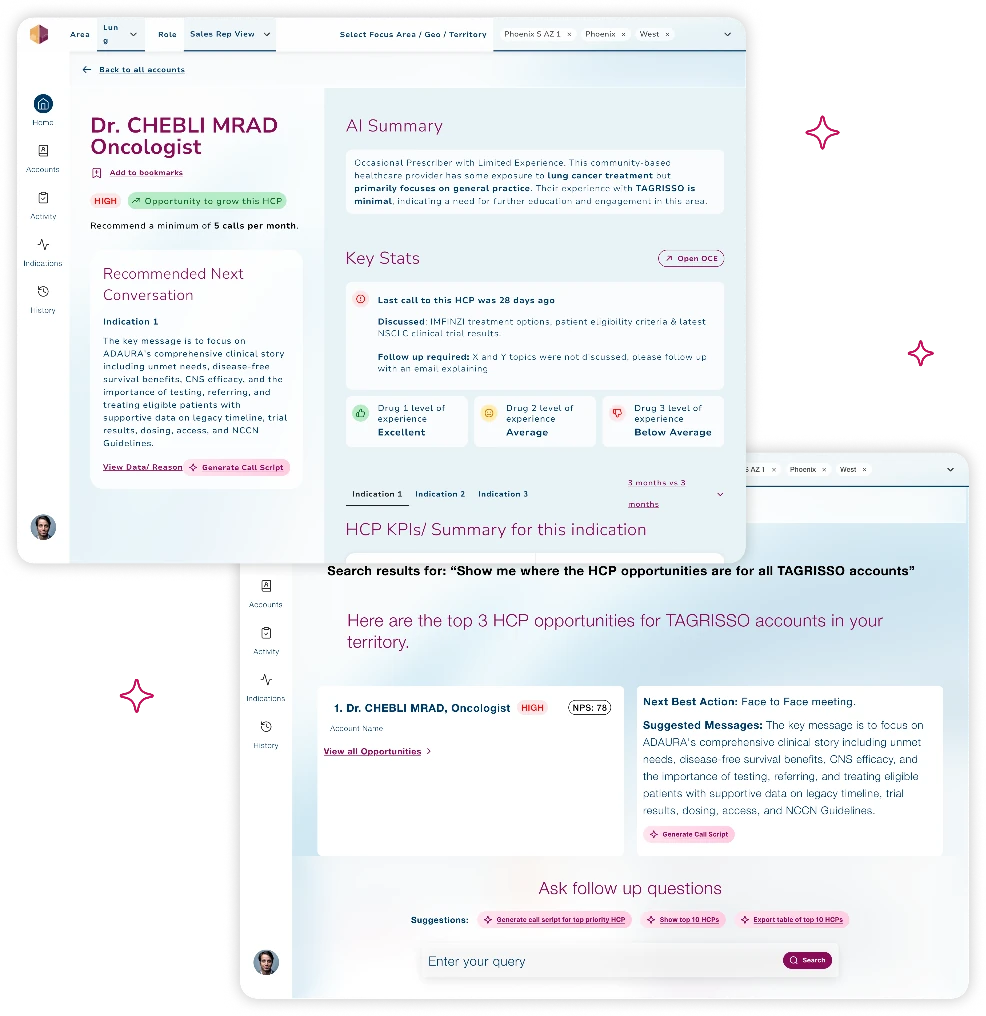
Every insight follows the same three-part pattern, so reps always know where to look and what to do.
The repetition is deliberate. Once a rep has learned the shape on one screen, every other screen is recognised rather than relearned: they spot the pattern instead of recalling where things live. That keeps the mental effort low in the few minutes between calls. Leading with what happened and why also gives the next step its reasoning, so the action at the end reads as a recommendation they can trust, not an instruction from a black box.
The same structure holds across every oncology brand and indication. Each new one arrives already familiar, which shortens the time from launch to a rep acting on it.
- 01What happened
- 02Why
- 03What to do next
04
The team
A retained team model, embedding strategy, UX and delivery expertise directly into AstraZeneca’s product team. I started with senior leadership at AstraZeneca, setting how we’d work and introducing my team to theirs. From there, Gabrielle led strategy, the design team ran UX and UI, and Emma kept delivery on track, with the team reporting to me. I also met regularly with the client to make sure we were meeting expectations and pushing the dashboard to a place where they felt it was a premier product inside the oncology unit, and AstraZeneca as a whole.
- StrategyGabrielle Alacchi
- UX & UI designSusanna Ward, Jodie Ballantyne, Alex Iannantuono
- DeliveryEmma Tang-Yuk
05
Outcomes
Less analysis, more selling
Reps spend their time on high-impact customer interactions.
Better sales outcomes
A more efficient platform tied to improved results in the field.
Recognized internally
The tool earned internal recognition and awards at AstraZeneca.
“The Appnovation team brings us a very impressive new experience design capability. With their skills mixed with [development partner’s] lean development, we can do big things for the rest of this year and years to come!”
06
Reflection
Using AI to sync data to clinical studies, and to decide how to go to market or which clinics and oncology professionals to prioritise, is highly complex. That’s exactly why the interface shouldn’t be.
AI earns its place when it distils the data down to its simplest terms and makes the next best action clear. The interface stays refined and simple until complexity genuinely needs to be introduced.